Hindu Kush, May '98
Surrounded by eager faces all keen to know what I'm doing - just the sight of
someone using a pen must be a novelty here.
Yesterday, left Faizabad - eventually. It was a 6am start what that meant was
that at 8am we sat down to tea at the driver's house, having spent the two previous
hours standing at a road junction waiting for the truck. Eventually we finally
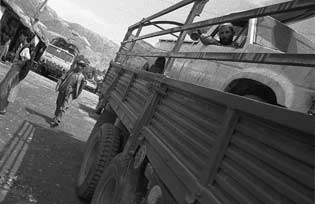
climbed aboard the 6x4 Kamaz - looted from Kabul and now on the World Food Programme's
Iskashem food run.
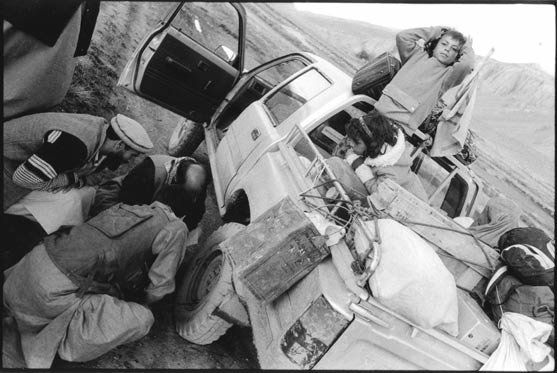
Having set off we went the wrong way - back to the new city where we collected
a Nissan pick-up which, when first towed had a seized engine; when it was dragged
behind the truck one wheel turned in each direction! After about three hundred
yards it started - amazingly, and was then squeezed into the truck, being fixed
in place by the expedient of letting down the tyres.
For the rest of the day the driver sat behind the wheel of this vehicle which was presumably being taken for sale in a town where it's mechanical state was unknown. The following morning it was seen in Baharak parked outside the house of some poor unsuspecting buyer who had proudly driven it the length of the main street - probably the last journey it would ever make under its own power.
The 40km journey from Faizabad to Baharak is generally estimated to take about
two hours in a Toyota HiLux or GAZ jeep. Four hours is considered a good safety
margin. Our truck finally arrived at 4.30 pm - a total time since the official
hour of departure of ten and a half hours, with only one puncture included as
a reasonable delay... (Slightly less than 4km per hour.)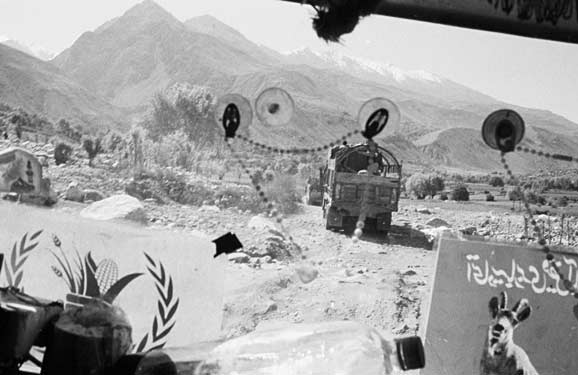
Stayed at the MERLIN house and ate at a meat, meat, gristle and rice restaurant. I picked it out of the rice and gave up on the stew with beans (and meat) side dish. Afghanistan is not always an easy place to be a vegetarian.
Slept soundly until 5.30 when I woke to discover that the truck was due to leave
at six. On this occasion it proved true, we were under way before seven, and
immobile at a mudslide before ten.
I watched a Kamaz driven into the mud by its driver intent on proving that his
6x6 could negotiate the liquid gloop which has covered the fields, roads and
crops. The truck sank to its axle and had to be ignominiously towed and dug
out! The drivers settled down to arguing about a suitable crossing point and
throwing stones into the mud.

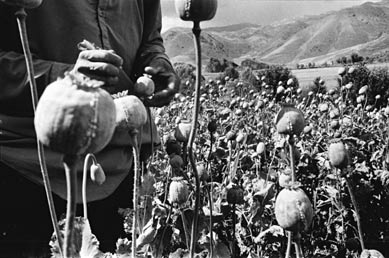
Beside me is a cannabis plant, growing wild on the edge of the road, a counterpoint to the carefully cultivated fields of opium poppies which surround us.
Already the climate is cooler although the sun still burns. I had to change
into a long sleeved shirt to avoid increasing the 'trucker's arm' sunburn which
I got yesterday. The peaks around our sorry scene of sunken - stranded vehicles
(almost the entire country's transport fleet by now) are snow covered but sadly
denuded of trees. The consequence of this free cutting of timber is the mudslides,
as everyone knows, but this is a country where survival is thought of as day
to day. Whilst I watched the chaos of the mud crossing a villager calmly chopped
down one of the last trees in the area and loaded the resulting firewood onto
his donkey.
23th May
Realisation dawns that we aren't going to get to Iskashem. After we crossed
that mudslide we came upon another. We'd already lost four hours with the first,
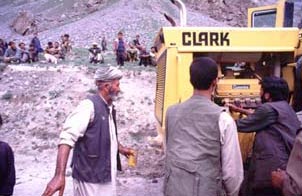
this one was worse - there was a bulldozer... This bulldozer belonged to Najmuddeen,
the Baharak warlord who is famed for carrying out executions by strangling the
victim personally. His driver refused to clear the mudslide unless he was paid
the extortionate sum of AF500,000 per driver, plus diesel. By now the convoy
included almost every functioning (if not roadworthy) truck in Northern Afghanistan
so his bribe would have totalled over $100. The drivers refused and parked up
for the night. We walked over the mudslide and made our way to a trucker's halt,
a teahouse by the road.
Seeking water and an escape from endless tea I later headed up the mountainside towards a village in search of a spring. One hour later I arrived at a jumble of walls and firmly closed doors which was apparently the village. Occasional glimpses of red scarves indicated the presence of women - if men are not supposed to see them why are they dressed in colours which naturally draw the eye? Eventually I decided that the answer is that they are easier to spot on the mountainside should they try to run away...
Finally I was guided to the spring, and watched carefully to ensure that I didn't
foul the water or steal too much. Then unceremoniously sent on my way - the
hoped for offer of hospitality in the village guest house was not forthcoming,
resulting in a scramble down five hundred feet of scree slopes and scrubby fields
in the darkening twilight. Rice supper at the teahouse. My Afghan companions,
the engineers employed by the Norwegian Afghan Committee NGO, shudder at the
thought of sleeping in the teahouse and produce an enormous aerosol of insecticide
with which they spray the platform upon which we are to sleep. I drift off to
the smell of bubblegum flavoured flea killer. Waking in the dark I stumble outside
to find an open space to urinate and find an electric storm of astonishing ferocity
flashing amongst the peaks. I'm lit up as though by a failing flourescent lamp.
24th May
Great news, the trucks have found a way round the mudslide and have arrived.
Then the discovery that the drivers are all going back to the previous village
we passed through. The road is supposed to be clear now all the way to Iskashem,
but the drivers have decided instead to hold a meeting and register a complaint
with the regional authorities, so we are still sat at the teahouse. It's incredibly
frustrating to sit rain-bound and knowing that our situation will become worse.
I'd hoped that friends from MSF might have come past by now since they're following our route, and, I hope, bringing my fleece and toothbrush which I'd failed to pick up when I left Faizabad, but sitting out of the rain in this tea house they will simply drive past without knowing I'm here - desolation! I'm doomed to spend all day in a dark tea house surrounded by people who seem fascinated with my every action.
In the centre of the tea house is a stove with a boiler built around the flue.
Periodically this is filled with river water and kept boiling, so with luck
we may escape typhoid. Arranged to each side are raised bed/seats where we ate
and spent the night. There are two windows, one a foot square, the other six
inches by three. Both are glazed with white plastic to save us from the effects
of too much sunlight. A vampire could probably spend a comfortable day drinking
tea here.
The walls of the establishment are mud, two feet thick. Together with three
central pillars they support the roof of heavy beams and mud, also two feet
thick. The sole real illumination comes from the door which is always open,
whilst in the kitchen at the other end of the building the light is provided
by the smoke hole which permits entry to a steady flow of rain. Currently in
the kitchen negotiations are underway to secure us some eggs, a hen sits in
the corner, its continued existence is dependent upon demand for eggs outstripping
demand for chicken.
Midday, we have returned from a trip to the village of Zu, a metropolis of sufficient
grandeur to merit mention on my map. It consists of eight family homes and a
stick insect discovered on the outskirts. However, they did us proud on the
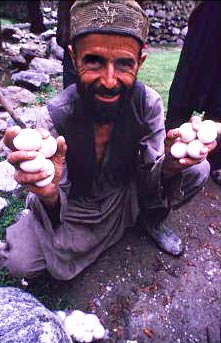
egg front People kept appearing with more and more handfuls, we must have taken
about thirty and a bowl of yoghurt which had to be drunk on the spot in the
absence of any means of transporting it. When we returned news of the potential
market had spread and half a dozen villagers appeared at the tea house to exchange
eggs for diesel-fuel for their lanterns and far more useful than paper money.
Otherwise, no bread, and to add to my frustration, I discover that our truck
driver hasn't gone with the others. He's snoozing in his cab, but he won't travel
without his mates, even though he'll meet up with them again at the next mudslide.
Rescue! Simultaneous with the return of the truck driver's delegation MSF appeared.
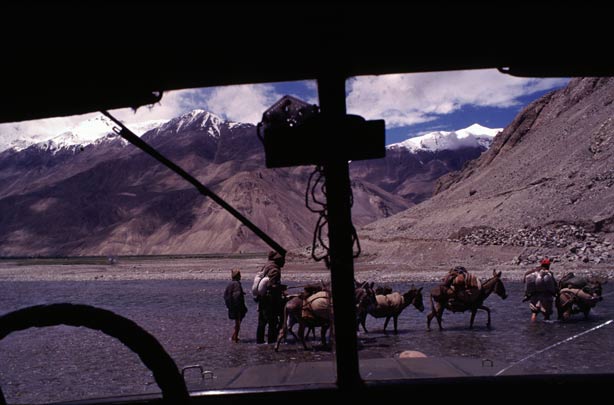
I've abandoned the engineers and thrown in with the medics. The GAZ jeep positively
flew along - until it wrecked its radiator fording a particularly deep river
crossing. Insecurely fixed it was pushed back_ by the water pressure into the
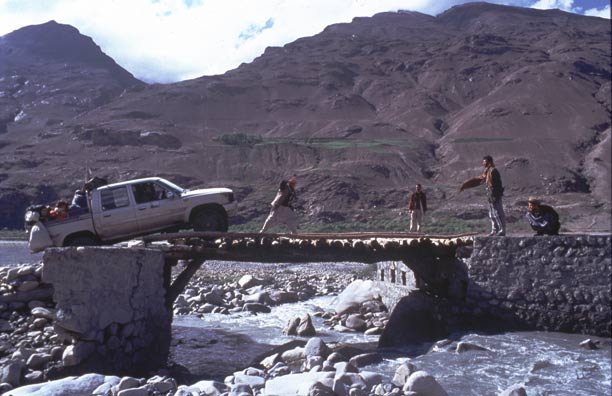
fan blades. Afghanaid are working on a seventeen metre bridge which will save
motorists to come, but in the meantime the river is bonnet deep.
This injury to the jeep had been preceded by the scrunching of a rear corner
when, on a low-ratio climb up a forty-five degree slope the transfer lever had
jumped into neutral. With great presence of mind the driver pulled up the handbrake
- to no effect. (Later I examined this lever and found it unconnected, a fact
he surely knew at the time!) We hurtled backwards with a three hundred foot
drop to the river beckoning, the driver swerved into the rockface and, with
a terrible grinding of metal we came to a halt. It was at this point we learnt
that the jeep has, in common with every other jeep in Badakshan, no functioning
brakes of any sort, a reassuring discovery to make when driving through the
Hindu Kush mountains!
26th May
In Wahan - currently in a damp sleeping bag; it was used as a cover during a
rain shower by the family in the back of the HiLux which brought us the final
leg of the journey from Iskashem. The jeep driver refused to go on, claiming
that the sole jerrycan of petrol we were able to find in town was of insufficient
quality - a somewhat unlikely claim given the state of tune of his Russian built
jeep's motor. In truth he'd lost his nerve after the radiator incident; he slowed
to a crawl for six inch deep puddles. Thomas, as the doctor of the party has
diagnosed hydrophobia.
Spent last night at a teashop near Zebok. There was a motionless pile of blankets
on one of the platforms. It turned out to be a "sick man". Thomas
pronounced bronchitis and dispensed the necessary drugs. In the morning he was
up and eating, a miracle of modern medicine!
We drove to Iskashem through fantastic mountain scenery, climbing to a watershed
and finally leaving the Kuchi river we had followed since leaving Faizabad.
The people here are Ishmaili and the women much less burkha'd, a consequence
of the Aga Khan's liberal influence. They wear flourescent red headscarves here,
visible against the mountains for miles, certainly their likelihood of escape
is compromised!
We puttered down the slope into town, our driver having by now abandoned all
pretence of having brakes, past the usual clutter of wrecked Russian APCs which
surround every town here. Bumping under a welcome arch we entered the two hundred
metre line of chicken huts which is Iskashem bazaar. I discovered that I already
knew about a third of the town's population, the trucks having passed us last
night after our retirement with a holed radiator.
Went for a walk to look at the bridge over the Oxus to Tadjikistan, then returned
to the crisis of the driver's refusal to go on. Thomas and Laurent had arranged
places for us on an ORA HiLux heading into Wahan, when it arrived I discovered
that it was the one I'd been going to travel on with the engineers. Obvious
really, it must have been the only motor vehicle going that way all month!
Fortunately three extra people didn't mean anyone was bumped off. The car set
off with seven passengers in the cab and seven more in the back for an 87 kilometer
drive on a route which could not charitably have been described even as a jeep
track. Since the car was also carrying supplies for the addiction detox clinic
in Wahan run by ORA, the NGO giving us a lift, and a year's clothes etc for
the family travelling there to work in the clinic, it was probably not surprising
that the springs were all broken and held together with old inner tubes wrapped
around them. It wasn't a record for the largest number of people caried in a
Hilux, coming back at one stage we managed nine in the back!
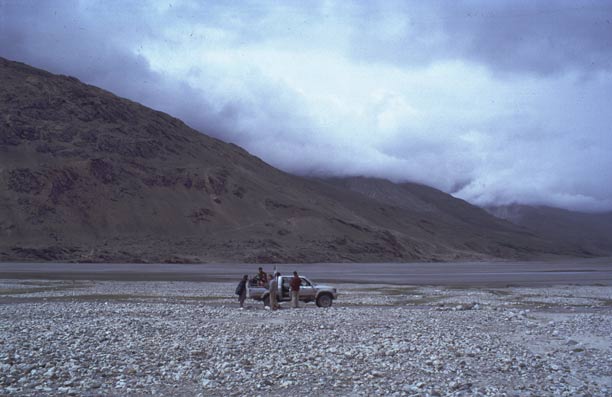
Fantastic landscape, all khaki with bright green trees marking each village
of four or five houses. Poor Thomas down with diarrhoea, luckily the ORA driver
has a bizarre habit of pouring cold water into the radiator each time the temperature
gauge creeps up to normal, so he had lots of opportunities. Unfortunately wherever
he went he found people, even in desert stretches he would disappear behind
a sand dune only to appear followed by a child.
Eventually arrived after one puncture and one getting lost.
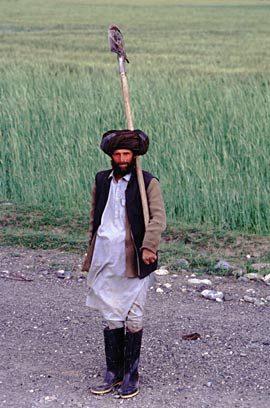
All the way we could see the Russian tarmac road on the other side of the river, they even had a hydro plant! People would whisper to us of the glories of Tadjikistan, the forbidden country protected by a Russian army even now; "over there they have electricity", "over there they have telephones" it is the showcase of the twentieth century to the Wahanis.
At one point every Afghan male in the pick-up began wildly waving out of the
window towards Tadjikistan. After staring to see what could have produced such
excitement I finally realised; the female tractor drivers on the opposite bank
were the source of their attentions - probably the first time any of them had
ever been waved to by a woman...
On this side the whispering children who held lanterns for us to get into our
sleeping bags have finally left, so we are alone with a Kirghiz opium addict.
Laurent says his sleeping bag smells of petrol.
27th May
Up at six for an immediate dash around the corner - liquid bowel syndrome; a
permanent affliction upon the whole community here to judge by the evidence
everywhere visible. Not really surprising in a town with no toilets where people
wash their hands in the irrigation channels, then drink from them!
Visited the ORA clinic before breakfast - four men and six women detoxing from
opium. All said it was because no health care available; the women take it when
they have pregnancy problems, the men for stomach pains - often hunger related
- or in the case of one, pain from an imperfectly healed right leg amputation;
a mine victim fifteen years ago when he was a government soldier south of Kabul.
It's a sign of his desperation that he's fled all the way here from the Taliban
who will kill him if they capture him since when he was injured all those years
ago it was as a soldier for the Soviet backed regime.
Afterwards off around town in the mountain drizzle, finally able to photograph
women, they're not happy about it, but they don't actually flee or threaten
me. Life here is so marginal that not only is the domestic dung collected but
also all from the fields and tracks. It's ground up by women and is then spread
on the fields. They're still ploughing prior to sowing the barley which will
be their one crop this season, harvested around September. Then that'll be it;
starvation rations over winter and nothing at all in the weeks before the next
harvest. It must have been like this for almost all of human existence - leaves
one wondering how people ever made the jump out of subsistence - probably painfully.
Seeing real intelligence in the occasional child's eyes is profoundly depressing
- most have the vacant look of the vast majority of people anywhere, compounded
by hunger, cold and a shallow genetic pool, but sometimes an intelligence gleams
through the dirt and the rags, and especially in the case of girls they'll never
learn to write their names. Shakespeare's Sister syndrome is the case in much
of the world, but out here women are said to have an average vocabulary of three
hundred and fifty words...
Interestingly the male director of ORA thought that women here with gynecological
problems would be prepared to be treated by a male doctor. The female doctor
was adamant that this was not the case, although as I explained, if they get
a medical team from Europe they'll have to take whatever comes - issues such
as security or availability may result in male rather than female staff, I suspect
that cultural reservations will adapt since these people know their need for
a clinic and understand that they can't turn anything down.
Now in a guest house just to the South of Iskashem having ridden back in the
ORA HiLux. We set off late in the cloud and the drizzle which has hardly relented
for our whole time in Wahan. Initially there were seven people in the cab and
nine, including Laurent, Thomas and myself, in the pickup section of the car.
Luckily it gradually thinned out!
At one point the driver hit a series of ditches whilst speeding, Thomas, who
was sitting on the tailgate bounced half a metre into the air.
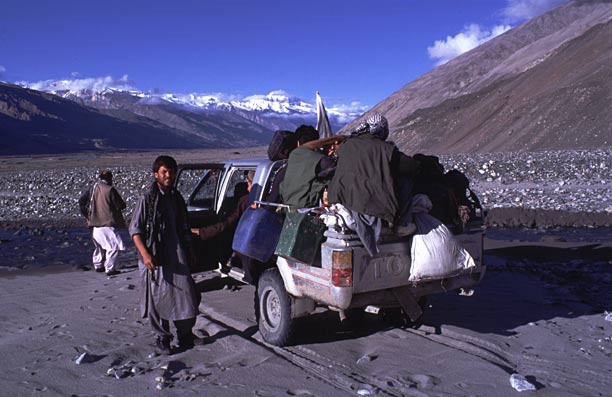
Had the same glorious views of the valley, albeit through cloud. The plates
have tilted by 45 degrees so that the Tadjik side of the river has slabs rising
straight from the Oxus to the snowline, whilst the Afghan side is the crumbling
escarpment. On the Tadjik side it appeared as though the flat land had been
tilted up, complete with paths and fields on the lower slopes, giving way to
woods and then snow fields.
Considerable traffic on the Tadjik side - two trucks and two jeeps spotted!
The road on that side of the river is a sealed asphalt highway, even roadsigns,
built by the Russian army which maintains a border quarantine zone. On my map
it is shown as a single faint line denoting a track, whilst on our side the
route which is often not defined at all is shown as a double line - cartographic
relativity!
Can't forget the child I came across minding animals, crouching in the shelter
of a rock. I suspect she'll not make it to adulthood although there's not much
for her to look forward to if she does get that far.
Just been trying to get to bed. Four people trying to get their sleeping bags,
quilts, mattresses etc. sorted, Jamin praying in the corner and our host attempting
to make the beds, lurking in the usual Afghan manner and attempting to throw
quilts over people who are perfectly comfortable, the usual chaos. He's nearly
knocked over the paraffin lantern already...
29th May
Home at MERLIN again. An exhausting
ride back from Iskashem, the journey which took three days to complete going
out done in one returning. At Baharak we were told the road was closed, then
someone in a tea shop said no it wasn't, they'd just come from Faizabad. Apparently
WFP had a bulldozer to clear the mudslides but the local farmers insisted on
doing the work in exchange for food - understandable since their fields have
just vanished. When we saw the damage the scale was impressive, at one point
a square kilometer must have been wiped out - there goes the harvest...
After Wahan the rest of Badakshan seems amazingly green and prosperous, all
things are relative.
Finally got solid bowels again! Still, I can't complain, poor Thomas was averaging
seven trips outside per night, no wonder he's somewhat subdued.
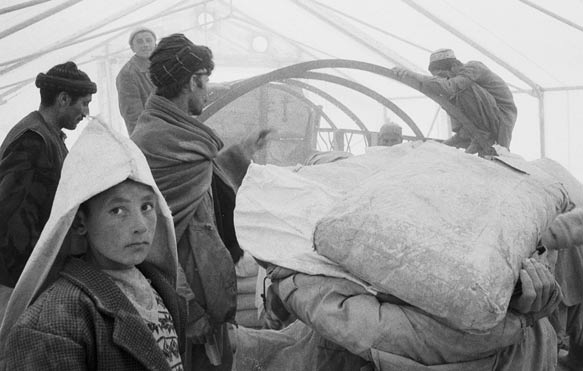
This morning we visited the WFP warehouses on the Tadjik border. Or, to judge
by the flag at the crossing point, the Russian border. The warehouses are enormous
white tents on an island in the middle of the Oxus river, seemingly at the end
of the world - one of the most desolate spots I've ever seen. Amazingly we just
drove right in, there appeared to be no one in charge except a supervisor from
Afghanaid who was organising loading trucks with cement. There would certainly
be no visa problems on this side of the border, if you crossed from Tadjikistan
it would be possible simply to walk in and get a lift on the next truck out.
- Of course it might not leave for a week!
Postscript: back for a couple of days in Faizabad and then while in the MERLIN
office suddenly the whole building shook! We rushed outside and after a while
it stopped, nothing damaged, but that was a much bigger tremor than most which
we had felt. A few hours later we started to get reports of how bad an earthquake
it had been, the next day there was an inter agency co-ordination meeting and
I was selected to be the logistician supporting the joint Red Cross, UN and
NGO team going in by helicopter to Shari-Borzorg where the epicentre had been.
We were going to see if there was anything still standing in this mountainous
region and, if possible, set up an emergency hospital to treat survivors of
what, it was becoming clear, had been a massive earthquake destroying villages
across a swathe of Afghanistan which was had no roads or communications and
was one of the most isolated and under developed places on the planet...
On to the Shari Borzorg Earthquake Photos...